Glycemic index gets the headlines, but glycemic load is the number you should actually use. The difference matters because GI ignores portion size — and portion is what determines your blood sugar response. Here’s the practical distinction and how to use both for A1C control.
Glycemic index in 60 seconds
GI compares how quickly a fixed 50g carb portion of a food raises blood glucose versus pure glucose (set at 100). Low GI = under 55, medium = 56–69, high = 70+. Problem: 50g of carb from watermelon is roughly six cups — nobody eats that. GI in isolation overstates real-world glucose impact for low-carb-density foods like fruit and vegetables.
Glycemic load fixes the portion problem
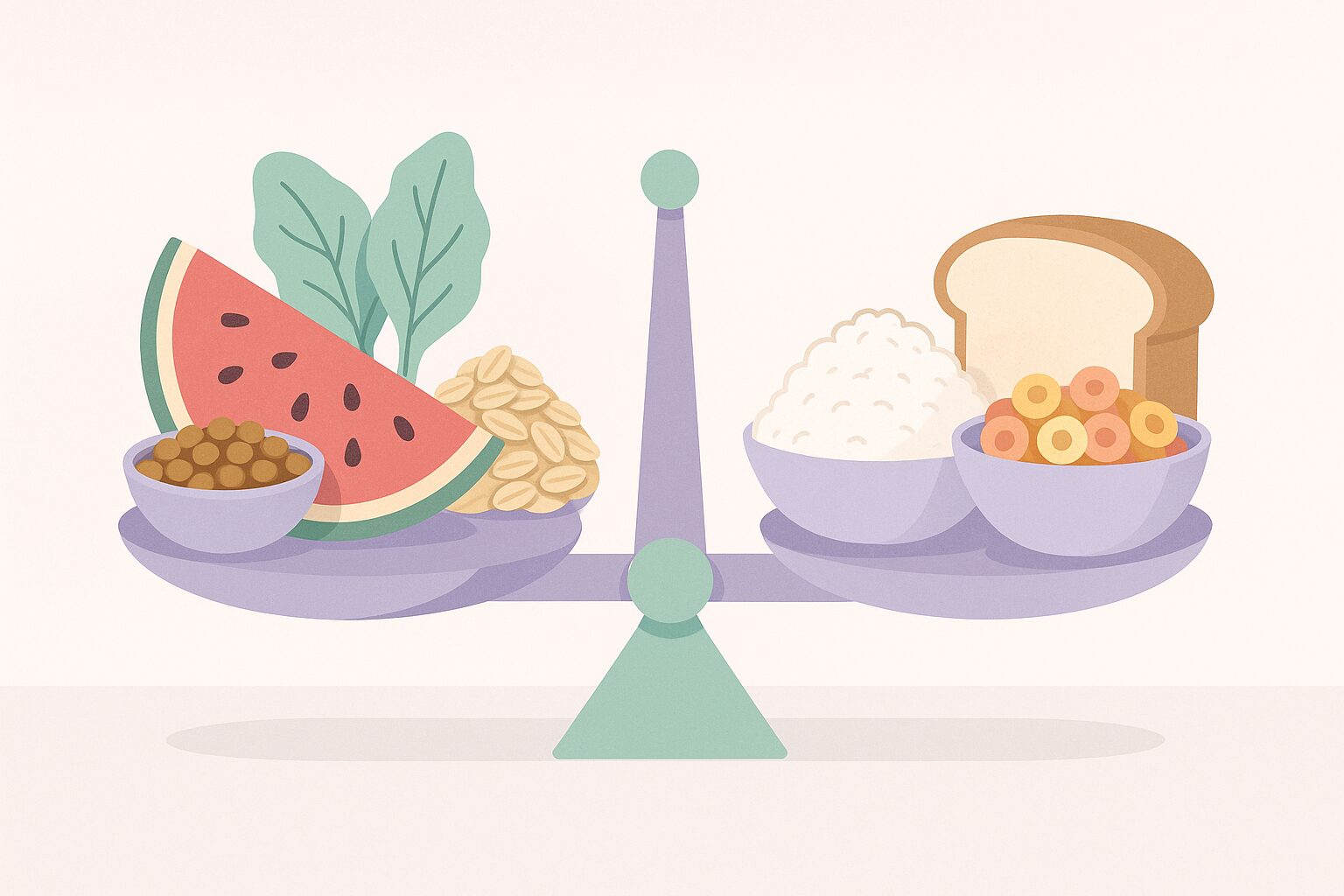
GL = (GI × carb grams per serving) / 100. It tells you the glucose impact of an actual portion. Low GL = under 10, medium = 11–19, high = 20+. Watermelon’s GI is 76 (high) but a normal cup has just 11g carb, giving a GL of 8 (low). This is why low-GL eating is more practical than chasing low GI.
How to use GL daily without a table
| Food | GI | Typical serving | GL | Verdict |
|---|---|---|---|---|
| White rice | 73 | 1 cup | 29 | High — small portion only |
| Watermelon | 76 | 1 cup | 8 | Low — eat freely |
| Steel-cut oats | 55 | ½ cup cooked | 10 | Medium — good base |
| Lentils | 32 | 1 cup | 9 | Low — daily staple |
| Whole-wheat bread | 74 | 2 slices | 20 | High — limit |
| Sweet potato | 63 | 1 medium | 17 | Medium — pair with protein |
Three practical rules
- Keep individual meals under 20 GL points
- Pair any medium/high-GL carb with protein, fat, or fiber to lower the effective load
- Fruit served whole almost always lands in low-GL territory — juice almost never does
GL is the carb-side of the equation. For meal building, our plate method guide gives the visual portioning rules, and fiber-first eating explains the sequencing that compounds GL benefits.
Frequently Asked Questions
Is GL always better than GI?
For meal planning yes. GI is still useful for comparing similar foods (which bread, which rice). GL is the better metric for total meal impact.
Do all diabetics need to track GL?
Tracking is not required — but learning the broad categories (low/medium/high) helps build instincts. After 4–6 weeks of awareness, most people stop tracking and intuit it.
Does cooking change GL?
Yes. Al dente pasta has lower GL than overcooked, and cooled-then-reheated rice has lower GL than freshly cooked (due to retrograde starch formation).
Sources & Further Reading
- NIH PubMed — Glycemic Index & Glycemic Load Tables
- ADA — Glycemic Index and Diabetes
- Harvard T.H. Chan — Glycemic Index Database
- Mayo Clinic — Glycemic Index Diet